
Your Comprehensive Testosterone Test Checklist: A Brisbane Longevity Guide
What if the "normal" result on your pathology report is actually the reason you still feel like a shadow of your former self? It's a common frustration for men across Brisbane who recognise that being "within range" is a far cry from thriving with peak vitality. If you've been told your testosterone...

What if the "normal" result on your pathology report is actually the reason you still feel like a shadow of your former self? It's a common frustration for men across Brisbane who recognise that being "within range" is a far cry from thriving with peak vitality. If you've been told your testosterone test results are fine despite a nagging sense of fatigue and declining muscle mass, you're likely looking for answers that standard screenings simply don't provide.
We understand that your health is not a statistic. It's a nuanced, personal pursuit of excellence. This guide is designed to help you master the clinical essentials of hormonal testing, providing the exact protocols needed to secure accurate, actionable data for your longevity journey. You'll learn the vital difference between total and free testosterone, the precise timing required for clinical validity, and how to find a specialist who prioritises your long-term health over mere population averages. This is about moving beyond basic diagnostics toward a sophisticated understanding of your own biology.
Key Takeaways
• Distinguish between total and free testosterone to understand the actual hormone availability within your tissues.
• Follow a precise clinical protocol for your testosterone test to ensure your results reflect your true physiological state.
• Identify the subtle symptoms of hormonal decline that often precede significant changes in blood markers.
• Recognise the distinction between standard laboratory reference ranges and the "optimal" levels required for long-term vitality.
• Learn the essential next steps for interpreting your data through a specialised longevity lens here in Brisbane.
Beyond the Basic Number: A Checklist of Essential Hormonal Markers
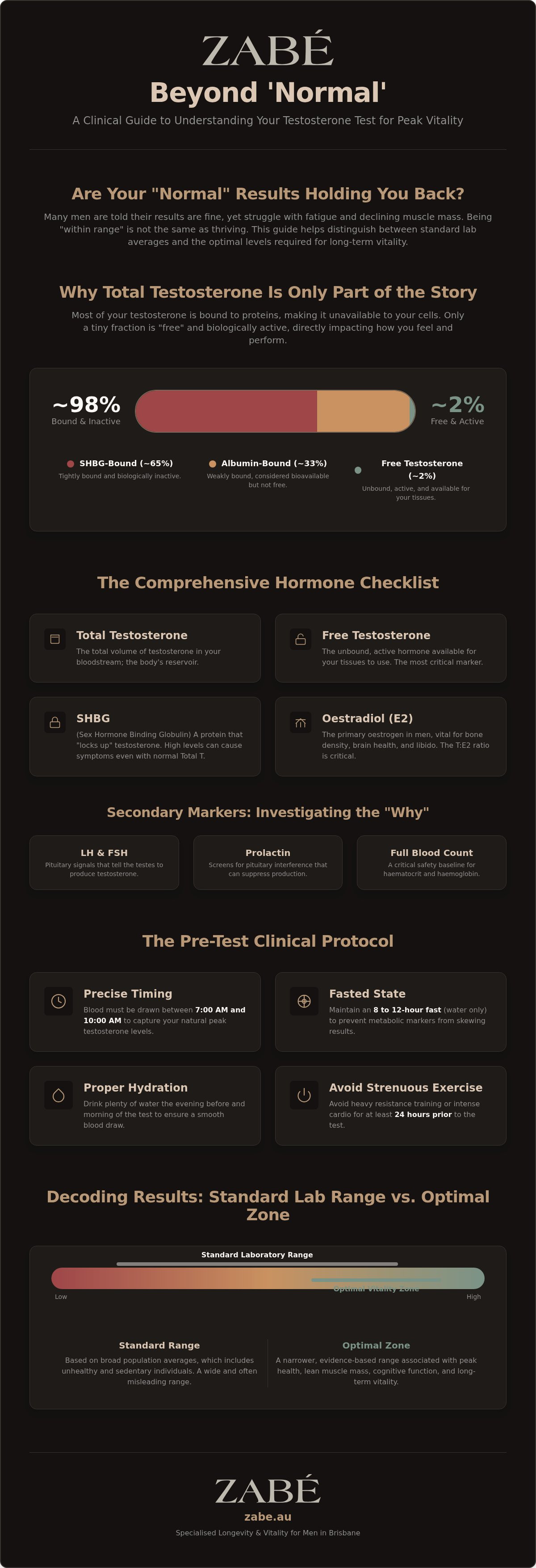
Precision. Depth. A standard testosterone test often yields a single figure, usually measured in nanomoles per litre (nmol/L) in Australia. While this total number is a useful baseline, it doesn't account for the complex biological sequestration that dictates how you actually feel. To move beyond the surface, we must examine the specific markers that define your hormonal landscape.
Total Testosterone
The absolute volume of Testosterone circulating in your bloodstream, representing the reservoir from which your body draws.
Free Testosterone
The unbound, active fraction of the hormone that's actually available for your tissues to use for muscle repair, cognitive function, and metabolic health.
Sex Hormone Binding Globulin (SHBG)
A transport protein that "locks up" your hormones; high levels can leave you symptomatic even if your total numbers look healthy.
Oestradiol (E2)
The primary form of oestrogen in men, critical for maintaining bone density, brain health, and a healthy libido.
Why "Total T" is rarely the full story
Relying solely on a total number is a diagnostic shortcut that often misses the mark. Most of the hormone in your system is bound to SHBG or albumin, leaving only a tiny percentage, usually around 2 to 3 percent, in its "free" state. If your SHBG is high, it acts like a biological cage, preventing your tissues from accessing the very hormone they need to thrive. This explains why many men in Brisbane are told their results are "normal" while they continue to struggle with fatigue and low motivation. We also look closely at albumin, a protein that weakly binds to the hormone. Bioavailable testosterone is defined as the sum of free and albumin-bound hormone.
Secondary markers for a comprehensive profile
A sophisticated testosterone test protocol also investigates why your levels are where they are. We measure Luteinising Hormone (LH) and Follicle Stimulating Hormone (FSH) to determine if the issue lies within the testes themselves or the pituitary gland's signalling. High prolactin levels are also screened to rule out pituitary interference that could be suppressing your natural production. Finally, a Full Blood Count (FBC) is essential. It provides a baseline for haematocrit and haemoglobin levels, which is a critical safety requirement before commencing any protocol involving testosterone replacement therapy. This comprehensive view ensures your longevity plan is built on a foundation of clinical rigour and personal safety.
Preparing for Your Blood Draw: The Clinical Protocol Checklist
Precision requires discipline. To ensure your testosterone test provides a clear reflection of your physiological potential, you must adhere to a strict clinical protocol before visiting the pathology centre. A haphazard approach to blood collection often results in skewed data, leading to unnecessary anxiety or, conversely, a false sense of security. By controlling the variables surrounding your draw, you ensure the results are a legitimate baseline for your longevity protocol.
Timing
Blood must be drawn between 7:00 AM and 10:00 AM to capture your natural peak.
Fasting
Maintain a fasted state for 8 to 12 hours, consuming only water, to ensure metabolic markers don't interfere with the assay.
Hydration
Drink plenty of water the evening before and the morning of your draw. Proper hydration improves blood viscosity, making the collection process smoother and more comfortable.
Exercise
Avoid heavy resistance training or high-intensity cardio for at least 24 hours prior. Intense physical exertion can cause transient fluctuations in hormone levels that don't reflect your baseline.
The "Morning Window" explained
Your endocrine system operates on a sophisticated diurnal rhythm. Testosterone levels naturally peak in the early morning hours and gradually decline as the day progresses. For a Testosterone Levels Test to be clinically valid, it must capture this morning surge. If you work night shifts or experienced significantly disrupted sleep the night before, your results may show a false "low" reading. We recommend Brisbane residents book the earliest possible appointment at their local pathology centre to ensure they remain within this critical window. At our Albion clinic, we prioritise these early consultations to ensure the integrity of your data is never compromised.
Lifestyle factors to pause
External variables can temporarily suppress your production, masking your true health status. Alcohol consumption, even a single drink the night before, can disrupt the delicate signalling between your brain and your testes. Similarly, acute stress triggers a rise in cortisol, which has an inverse relationship with your primary androgen. It's also vital to disclose any supplements you're currently taking, particularly those containing biotin or herbal "boosters," as these can interfere with the laboratory's testing equipment. If you're unsure about your current regimen, a longevity consultation can help clarify which factors might be clouding your results. By controlling these variables, you transform a simple blood draw into a definitive diagnostic tool for your future vitality.
Symptom Tracking: The Subjective Assessment Checklist
Numbers on a page are static data points until they're viewed through the lens of your daily experience. While a testosterone test provides the clinical "what," your symptoms reveal the "so what." Clinical "normalcy" often masks a significant decline in quality of life, making it essential to document the subtle shifts in your vitality before your consultation. We view your subjective experience as a vital diagnostic tool that complements your pathology, providing a complete picture of your hormonal health.
Energy and Vitality
Track your afternoon "slumps" and general motivation. If you find yourself reaching for a third coffee at 3 PM just to function, it's rarely just a sign of a busy week.
Cognitive Function
Identify "brain fog" or difficulty concentrating on complex tasks. Androgens play a critical role in neuroprotection and mental clarity; their decline often manifests as a lack of "edge" in professional settings.
Physical Composition
Note unexplained weight gain, particularly visceral fat around the abdomen, or a noticeable loss of muscle tone despite consistent resistance training and a controlled diet.
Mood and Sleep
Assess levels of irritability and the quality of your REM sleep. Disrupted sleep architecture is often both a cause and a symptom of hormonal imbalance, creating a feedback loop of fatigue.
The ADAM Questionnaire approach
The Androgen Deficiency in the Ageing Male (ADAM) framework is a validated screening tool used to identify potential hormonal issues. It focuses on ten key areas, including libido, strength, and work performance. We encourage you to note not just the presence of these symptoms, but their onset and duration. This longitudinal view is invaluable when considering systemic recovery options, such as peptide therapy, which can work in tandem with other interventions to restore your physiological baseline. It's about identifying patterns rather than isolated incidents.
Quantifying the "Unquantifiable"
Assigning a numerical value to your feelings can bridge the gap between intuition and evidence. Use a 1 to 10 scale to track your libido and the frequency of morning erections, as these are often the first indicators of a shifting hormonal profile. Document your recovery times after a gym session or a long day at work. If a routine that once felt effortless now leaves you drained for days, your androgen levels may be insufficient. Bringing these quantified notes to our specialist clinic in Albion allows for a more nuanced interpretation of your testosterone test, ensuring your care is as individual as your biology.
Decoding the Results: Optimal Ranges vs. Laboratory Standards
Receiving your results is often the point where confusion sets in. Most Australian laboratories define a normal total testosterone range between 8 and 30 nmol/L. However, this statistical bell curve is derived from a vast cross-section of the population, including those with chronic illness, high stress, and sedentary lifestyles. Being at the bottom of this "normal" range might mean you're clinically clear of disease, but it rarely means you're operating at your peak. For many men, an optimal range sits more comfortably between 15 and 25 nmol/L, where the physiological benefits of the hormone are most pronounced.
Age-adjusted expectations are equally vital. A healthy 40-year-old should not be satisfied with the hormonal profile of a 70-year-old, even if they both technically fall within the same laboratory parameters. We also look beyond the primary number to the T:E2 ratio. Oestradiol is not just a female hormone; it's essential for male health, but its balance with testosterone dictates your mood, body composition, and cardiovascular protection. Interpreting your testosterone test requires looking at how these markers intersect rather than viewing them in isolation.
Why "Normal" isn't always healthy
Reference ranges are a tool for identifying pathology, not for defining excellence. Because these ranges are calculated using a broad population average, they often fail to account for bio-individuality. Your unique androgen receptor sensitivity means you might feel symptomatic at a level that another man finds perfectly adequate. Our philosophy at ZABÉ is to treat the patient, not just the paper. We prioritise your reported symptoms and longevity goals over a rigid adherence to outdated statistical averages, ensuring your protocol is tailored to your specific biological needs.
Red Flags in your pathology report
A comprehensive review can uncover underlying health issues that a standard GP visit might overlook. For instance, extremely low SHBG is often a red flag for metabolic dysfunction or insulin resistance, regardless of your testosterone levels. We also monitor haematocrit levels with precision. A high haematocrit reading increases blood viscosity, which can have significant implications for cardiovascular health and must be managed proactively. If your results have left you with more questions than answers, we invite you to book a clinical review at our Albion clinic for a comprehensive, specialised interpretation of your data.
The Path to Vitality: Next Steps After Your Testosterone Test
A single testosterone test is a valuable diagnostic snapshot, yet it is rarely the final word on your health. True longevity is a dynamic process, requiring a commitment to both clinical data and consistent lifestyle refinement. Once you have your results, the focus shifts from measurement to management. This is the point where you decide how to bridge the gap between your current state and your peak potential.
Lifestyle Interventions
Optimised nutrition, restorative sleep, and progressive resistance training remain your first line of defence. These habits create the physiological environment necessary for any protocol to succeed.
Clinical Review
Consulting a longevity specialist ensures your data is interpreted within the context of your specific goals rather than population averages.
Medical Protocols
For men whose levels remain suboptimal despite lifestyle changes, exploring trt australia options can provide the necessary foundation for systemic recovery.
Ongoing Monitoring
Hormonal health evolves. Regular follow-up testing allows for the precise titration of any interventions, ensuring long-term safety and efficacy.
The Albion Clinical Experience
At ZABÉ in Albion, we offer a boutique environment that stands in stark contrast to the hurried nature of high-volume pathology centres. Our consultations are intentional and thorough, allowing us to understand the man behind the markers. We often integrate hormonal data with broader aesthetic goals, such as facial balancing, to ensure your external appearance reflects your internal vitality. This holistic approach avoids "one-size-fits-all" scripts in favour of a personalised longevity plan that respects your individual nuance.
Booking your assessment in Brisbane
Taking control of your hormonal health begins with a structured clinical pathway. You can organise your initial blood draw and follow-up consultation directly through our Albion clinic, where we guide you through every step of the testosterone test process. When you arrive for your first appointment, please bring any previous pathology reports and a list of current supplements to help us build a comprehensive history. This is your opportunity to move beyond feeling "off" and start a methodical journey toward sustained vitality. Your future health is a choice; we invite you to make it with the guidance of a trusted clinical partner.
Securing Your Physiological Future in Brisbane
Understanding your internal chemistry is the essential foundation of any serious longevity strategy. By adhering to a strict testosterone test protocol and looking beyond standard reference ranges, you move from frustrating guesswork to clinical certainty. You now recognise that "normal" is merely a statistical average, whereas your personal health requires a more refined, age-adjusted benchmark that prioritises how you actually feel and function in your daily life.
At ZABÉ in Albion, we combine scientific rigour with a polished, boutique approach to men's health. Our expertise in longevity and aesthetic medicine allows us to craft personalised TRT and peptide protocols that focus on systemic balance and long-term vitality. If you are ready to move beyond the limitations of high-volume pathology and seek a specialist who values your individual nuance, we invite you to Book Your Longevity Consultation at ZABÉ Albion. Take the first step toward a future defined by clinical clarity and a renewed sense of strength. Your journey to optimal health deserves the highest level of care and discretion.
Frequently Asked Questions
Do I need a GP referral for a testosterone test in Brisbane?
No, you don't strictly need a GP referral to access a private testosterone test in Brisbane. Many men choose to bypass the standard pathology route by opting for private clinical assessments that provide a more comprehensive breakdown of markers than a standard government-funded screen. However, if you're seeking a Medicare rebate, a referral from a general practitioner is mandatory. At ZABÉ, we guide you through this process to ensure your data is captured with clinical precision.
Can I take a testosterone test if I am currently sick or have a cold?
It's best to wait until you've fully recovered from a cold or flu before undergoing testing. Acute illness triggers an inflammatory response that can temporarily suppress your hormonal axis, leading to a result that doesn't reflect your true physiological baseline. To ensure your data is actionable and accurate, schedule your draw when you're in good health. This prevents a false "low" reading from skewing your long-term longevity protocol or causing unnecessary concern.
How much does a comprehensive testosterone blood test cost in Australia?
Private pathology fees for a testosterone test in Australia vary depending on the complexity of the biomarkers being analysed. While a basic total testosterone screen is the most accessible option, comprehensive panels that include free testosterone and SHBG involve a higher out-of-pocket cost. These private panels are often preferred by men who want a detailed physiological map without the strict clinical constraints of government-funded pathology.
Will a testosterone test show if I am infertile?
A hormonal screen provides essential clues about your reproductive health, but it isn't a definitive test for infertility. While low testosterone or abnormal signalling hormones can certainly impact sperm production, a specific semen analysis is required to assess fertility directly. We use these hormonal markers as part of a wider diagnostic picture to understand how your endocrine system is supporting your overall vitality and systemic function.
How long does it take to get testosterone test results back?
Most results are available within 24 to 72 hours after your blood draw. Simple panels are often processed quickly, while more complex assays involving multiple hormonal markers or specialised mass spectrometry may take slightly longer. Once the laboratory releases the data, we review the findings through a longevity lens rather than just checking for "normal" ranges. This ensures you receive a sophisticated interpretation that aligns with your specific health and aesthetic goals.
Can I test my testosterone levels using a saliva kit instead of blood?
While saliva kits are available, blood serum testing remains the gold standard for clinical accuracy in Australia. Saliva tests can be prone to fluctuations based on recent oral intake or gum health, making them less reliable for directing a medical protocol. We prioritise venous blood draws because they provide the most consistent and precise measurement of both total and free hormone levels, ensuring your longevity plan is based on high-quality data.
Does Medicare cover the cost of a testosterone test?
Medicare provides a rebate for testing if it's deemed clinically necessary by a medical professional. The specific Medicare item number for this is 66695. However, the criteria for bulk-billing are often quite strict, focusing on identifying major pathology rather than optimising vitality. Many of our clients choose private testing to access a more detailed array of biomarkers that fall outside the standard government-funded diagnostic parameters.
What is the best time of day to have my blood drawn for a testosterone test?
For clinical validity, your blood should be drawn between 7:00 AM and 10:00 AM. This early window is critical because androgen levels follow a diurnal rhythm, peaking shortly after you wake up. Drawing blood later in the afternoon can result in a reading that is significantly lower than your morning peak. Adhering to this timing ensures your results are comparable to established clinical benchmarks and representative of your true potential.